

Knowledge Trust Ladder
This page is for readers aged 13 to 18. It retells the architecture page in shorter words. The full page has every detail.
What does it do?
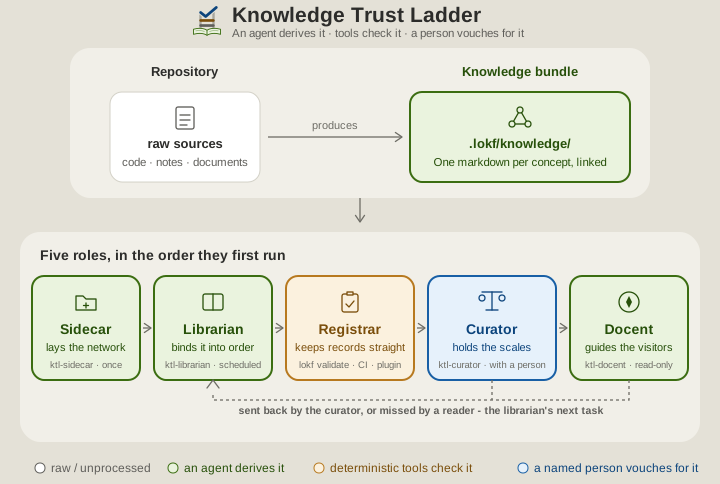
Section titled “What does it do?”Knowledge Trust Ladder (KTL) keeps a repository’s knowledge as a collection. Each entry shows where it came from and how far it has been checked.
Three things can happen to every entry, and the bundle records which of them happened:
- An agent derives it.
- Deterministic tools check it. A check gives the same answer every time.
- A named person vouches for it.
Why does a project need it?
Section titled “Why does a project need it?”The knowledge already exists, in code, documents, diagrams and policies. But every task starts the same way. Someone finds the material, connects it, and judges what is still true. Then the next person or assistant does that work again.
A knowledge bundle keeps that work instead of throwing it away. It is a plain folder of Markdown concept files, like a library’s catalogue. It sits between the sources and whoever reads them, a person or an agent. It lasts from one task to the next.
A catalogue is useful only when a reader can tell which entries are sound. So each entry answers one question: who is responsible for the quality of this context?
Who does the work?
Section titled “Who does the work?”KTL names its roles after people who work in libraries and museums. Four of the roles are Agent Skills.
- The sidecar sets the project up, once. It adds
.lokf/, a folder beside the code like.git/, kept out of the project’s build. - The librarian fills the bundle, often and on a schedule. It reads the repository, writes each concept with its sources, and links the concepts together. It records facts about the repository, never verdicts about truth.
- The curator is always a person, and the skill only helps. It puts the source next to each claim. The person decides: confirm, correct, retire or send back.
- The docent answers questions from the bundle, and says how far each answer has been checked. Docent is a museum’s name for a guide. When the bundle has no answer, the docent records the miss for the librarian. It never changes the bundle.
The fifth role, the registrar, keeps the records in order, and programs do that job. The lokf toolkit checks every change. On each pull request that touches the bundle, knowledge-registrar.yaml checks it in continuous integration (CI).
The librarian writes the bundle only through one script, knowledge-apply.sh, called the pen. The pen stamps who wrote each record, and when. It refuses a change that would fake or remove a person’s confirmation. Another script, knowledge-report.sh, works out each trust label, so no model does that arithmetic.
One more skill has no role of its own. ktl-prose is the librarian’s copy editor. It rewords what an agent wrote in plain English, and changes the wording but never a fact.
Another, ktl-website, builds a website from the bundle. Anyone can browse the bundle on that website and see each entry’s label.
How far can you trust an entry?
Section titled “How far can you trust an entry?”Each entry carries a label in plain words:
- Confirmed by a person: a named person checked it against its source.
- Checked by automation only: automation re-checked that the source still matches, and no person has.
- Nobody has checked this yet: no check of any kind is recorded.
Other labels say an entry is still a draft, edited since a person last confirmed it, past its review date or retired. Reopened means a person confirmed it, and a new question is waiting.
The labels are worked out from each entry every time it is read, and never stored. So they always agree with what they describe. The number to watch is confirmed by a person: n of N. It is meant to rise slowly, a handful of entries in a sitting.
Where can I read more?
Section titled “Where can I read more?”- install.md: how to install the skills, and which ones to start with.
- for-the-curious.md: who writes the bundle and what checks it.
- The bundle’s glossary: what the project’s own words mean, such as sidecar, registrar, docent, desk and the pen.
- obsidian.md: the bundle in Obsidian, and the two plugins.
- CONTRIBUTING.md and SECURITY.md: how to help, and how to report a security issue.
Who made the parts?
Section titled “Who made the parts?”Nolan Nichols created LOKF, the format the bundle is written in. This is an independent project, not an official distribution of LOKF or of the Open Knowledge Format. It is released under the Apache License 2.0.