

Load the graph into Neo4j
Governance data is a graph: risks relate to controls, controls implement obligations, obligations trace to frameworks. These steps fetch the Cypher export that ai-atlas-nexus publishes, start Neo4j in a container, load the file, and open it in the browser. They need the Install step done, and podman or docker. The flags below are the same for both.
Where the Cypher comes from
Section titled “Where the Cypher comes from”This project generates no Cypher of its own. ai-atlas-nexus regenerates graph_export/cypher/ai-risk-ontology.cypher on every merge and tags each release, so the file at the tag of the installed package is built from the same packaged data the API, the CLI and the web UI serve. scripts/fetch_cypher.py downloads that file for the installed version (importlib.metadata.version("ai-atlas-nexus"), 1.2.5 at the time of writing) from https://raw.githubusercontent.com/IBM/ai-atlas-nexus/v<version>/graph_export/cypher/ai-risk-ontology.cypher. The file is about 2.8 MB and is not committed here. graph/cypher/README.md says so for anyone who finds the directory empty.
The saved file starts with three comment lines, which Cypher ignores:
// source: https://raw.githubusercontent.com/IBM/ai-atlas-nexus/v1.2.5/graph_export/cypher/ai-risk-ontology.cypher// fetched: 2026-10-10A second run reads those lines and downloads again only when the installed version has changed. --force downloads regardless, and --version 1.2.4 fetches another tag. The script reports a missing tag or file in one sentence and exits 1.
Walkthrough
Section titled “Walkthrough”-
Fetch the Cypher. Either command writes
graph/cypher/ai-risk-ontology.cypher. The API’sGET /graph?id=cypher&export=truedoes the same and answers with the version and the path.Terminal window just fetch-cypher./ai graph cypher --export -
Start Neo4j, with
graph/cypher/mounted wherecypher-shellcan read it. Choose a password.Terminal window podman pull docker.io/library/neo4jpodman run --name ran_neo4j --rm --volume $(pwd)/graph/cypher:/examples --publish=7474:7474 --publish=7687:7687 --env NEO4J_AUTH=neo4j/<choose-a-password> docker.io/library/neo4j:latest -
Load the file from a second terminal.
Terminal window podman exec --interactive --tty ran_neo4j cypher-shell -u neo4j -p <your-password>:source /examples/ai-risk-ontology.cypher -
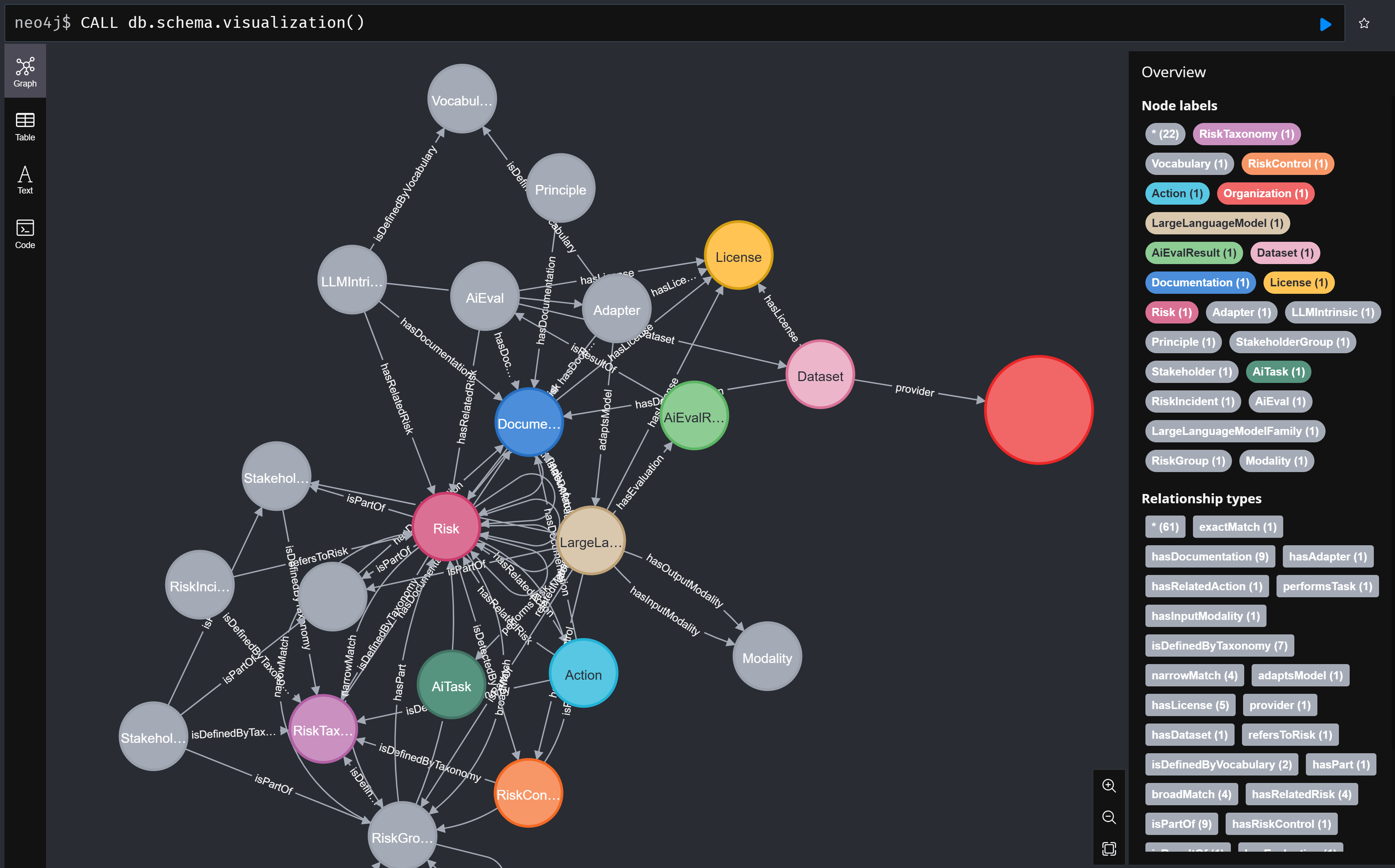
Look at it. Open the Neo4j Browser, log in as
neo4jwith your password, and runCALL db.schema.visualization(). .assets/neo4j.png shows what to expect.
What the file does not contain
Section titled “What the file does not contain”Your own data is not in it. The artefact is built upstream from the packaged ontology, so the files under byo/data cannot appear in the graph. ./ai graph cypher --export --byod and GET /graph?id=cypher&export=true&byod=true are refused with a 400 that says so, rather than returning a file that silently leaves your uploads out. The YAML export, ./ai graph --export --byod, does include them.
Known defects in the upstream artefact
Section titled “Known defects in the upstream artefact”These are upstream’s to fix. The owner has reported them with a fix on a branch of IBM/ai-atlas-nexus. A newer tag will carry the fix once it is merged, and just fetch-cypher will pick it up when the installed package moves to that version. Nothing here works around them.
- In the owner’s count against upstream’s current artefact, 3,338 of 9,835 edge statements match no node. Edges point at a slot’s declared range label rather than the node’s actual label, at enum values (31 edges to
AdapterType, 129 toAIUC1EvidenceCategory) for which no node is ever created, and at six identifiers with no node at all.cypher-shellaccepts the statements, but theMATCHfinds nothing and the edge is not created. - Multivalued values are written as Python list representations in a string, such as
"['a', 'b']", rather than as Cypher lists. - Values are interpolated without escaping, so a quote or a backslash inside a description can break a statement.
The route not taken: RDF
Section titled “The route not taken: RDF”The schema-generic alternative is to stop at RDF. linkml-convert writes the same data as Turtle from the LinkML schema with no graph-specific code, and Neo4j’s neosemantics plugin imports that losslessly, with rdf:type as labels and multivalued literals as arrays. It would remove the defects above and serve any triplestore, at the cost of a plugin install on a self-hosted Neo4j, a uri property on every node, and shortened property names. It is the alternative on record, and is not built.
The graph door is the fourth of the four access patterns. byo/notes/EXAMPLES.md walks through all four with a real incident.